


AURA is the first open-source, speech-native assistant capable of completing complex, goal-driven tasks through dynamic tool invocation and multi-turn conversation.

- Speech-Native: Full speech-to-speech interaction with natural conversation flow
- Tool Integration: Dynamic tool invocation for calendar booking, contact lookup, web search, email, and more
- Multi-Turn Dialogue: Maintains context across conversation turns for complex task completion
- Modular Design: Easy integration of new tools using natural language prompts and action classes
- Open-Source: Built entirely with open-weight models (ASR, TTS, LLMs)
- High Performance: 92.75% on OpenBookQA (outperforming all open-weight systems), 90% task success on human evaluation
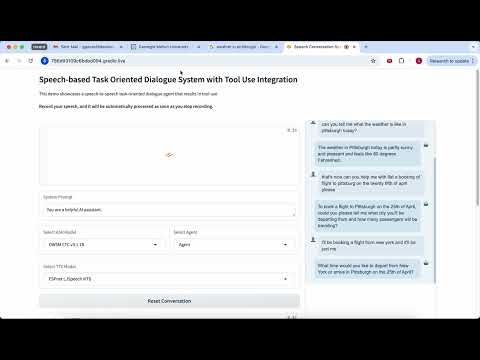
AURA employs a cascaded pipeline architecture that combines:
- ASR (Automatic Speech Recognition): Converts speech input to text
- LLM Agent: Processes text, reasons about tasks, and decides on tool usage using ReAct-based reasoning
- TTS (Text-to-Speech): Converts agent responses back to natural speech
- Tool Integration: Seamless integration with external APIs and services
.
├── agent/                      # Core agent implementation
│   ├── actions/                # Action handlers for different tasks
│   │   ├── calendar_action.py  # Calendar booking functionality
│   │   ├── contact_action.py   # Contact lookup
│   │   ├── email_action.py     # Email composition and sending
│   │   ├── web_search_action.py # Web search capabilities
│   │   └── chat_action.py      # General chat functionality
│   ├── controller/             # Agent state and control logic
│   ├── llm/                    # Language model integration
│   ├── agenthub/               # Agent implementations (QA, Chat agents)
│   ├── speech_utils/           # Speech processing utilities
│   ├── dst/                    # Dialog State Tracking components
│   └── secrets_example/        # Example credential configuration
│
├── ui/                         # User interface components
│   ├── local_speech_app.py     # Gradio-based speech interface
│   └── requirements.txt        # UI-specific dependencies
│
├── accent_adaptive_asr/        # Accent-adaptive ASR with fine-tuning
│   ├── asr_ft.py              # ASR fine-tuning script
│   ├── evaluate.py            # ASR evaluation utilities
│   └── config/                # ASR configuration files
│
├── dst/                        # Dialog State Tracking fine-tuning
│   ├── finetune/              # DST model fine-tuning scripts
│   ├── generate/              # DST inference scripts
│   └── evaluation_JGA_DSP/    # DST evaluation metrics
│
├── evaluation/                 # Evaluation frameworks
│   └── voicebench/            # VoiceBench evaluation scripts
│
├── llm_serve/                  # Language model serving utilities
│
├── docs/                       # Documentation and assets
│   └── images/                # System diagrams and screenshots
│
└── environment.yml            # Conda environment configuration
- Python 3.9+
- Conda or Miniconda
- CUDA-compatible GPU (recommended for optimal performance)
-
Clone the repository
git clone https://github.com/Sentientia/Aura.git cd Aura -
Create the conda environment
conda env create -f environment.yml
conda activate sentientia
-
Set Python path
export PYTHONPATH=$PYTHONPATH:$(pwd)
-
Set LLM environment variables
export LLM_API_KEY="your_api_key_here"
export LLM_API_BASE="your_api_base_url"
export LLM_MODEL="your_model_identifier"
-
Setup tool credentials (Required for tool use, optional for chat-only functionality)
- Google Cloud Platform: Set up GCP account, enable necessary APIs, and place
credentials.json - Setup credential with the help of examples in agent/secret_examples
- Google Cloud Platform: Set up GCP account, enable necessary APIs, and place
- Launch the speech interface
python ui/local_speech_app.py
AURA achieves strong performance on multiple benchmarks:
- VoiceBench OpenBookQA: 92.75% (outperforming all open-weight systems, approaching GPT-4o)
- AlpacaEval: 4.39 (competitive with other open-weight systems)
- Human Evaluation: 90% task success rate on complex, multi-turn speech tasks
AURA's modular design makes it easy to add new tools:
- Create a new action class in
agent/actions/ - Implement the required methods following the existing action patterns
- Provide natural language explanation in the agent prompt.
- Route to appropriate Action class in agent step method.
Example action structure:
from agent.actions.action import Action

class MyCustomAction(Action):
    def __init__(self, thought: str, payload: str):
        super().__init__(thought, payload)

    def execute(self, params):
        # Implementation here
pass- 📅 Calendar: Book appointments
- 👥 Contacts: Look up contact information
- 🔍 Web Search: Search the web for information
- 📧 Email: Compose and send emails
- 💬 Chat: General conversation and question answering
- Check the Issues page for known problems
- Review the paper for technical details and methodology
- Examine the example configurations in
agent/secrets_example/ - Raise a new issue if your question is not answered.
This project is part of ongoing research in speech-native AI assistants. For detailed technical information, please refer to our paper:
"AURA: Agent for Understanding, Reasoning, and Automated Tool Use in Voice-Driven Tasks"
Leander Melroy Maben, Gayathri Ganesh Lakshmy, Srijith Radhakrishnan, Siddhant Arora, Shinji Watanabe
Research data and annotations are available at: Google Sheets
We welcome contributions! Please feel free to submit issues, feature requests, or pull requests.
This project is open-source. Please check the repository for license details.
If you use AURA in your research, please cite our paper:
@misc{maben2025auraagentunderstandingreasoning,
      title={AURA: Agent for Understanding, Reasoning, and Automated Tool Use in Voice-Driven Tasks},
      author={Leander Melroy Maben and Gayathri Ganesh Lakshmy and Srijith Radhakrishnan and Siddhant Arora and Shinji Watanabe},
      year={2025},
      eprint={2506.23049},
      archivePrefix={arXiv},
      primaryClass={cs.AI},
      url={https://arxiv.org/abs/2506.23049},
}We thank the open-source community for the foundational models and tools that made AURA possible, including ESPnet, Transformers, and the broader speech and NLP research community.