다음은 버블정렬, 선택정렬, 삽입정렬, 쉘정렬을 구현하고, 각 배열별로 정렬된 상태(랜덤, 내림차순 정렬, 대부분 정렬)에 따른 수행시간의 차이를 알아본다.
import java.util.*;

interface SortMethods{ //정렬 방법
    void bubbleSort(int[] x,int n);
    void selectionSort(int[] x,int n);
    void insertionSort(int[] x,int n);
    void shellSort(int[] x,int n);
}
interface SortDegree{ //배열의 정렬 정도
    void random(int[] x,int n); //랜덤
    void descendingSort(int[] x,int n); //내림차순 정렬
    void almostSort(int[] x,int n); //거의 정렬이 되어있는 상태
}
class Sort implements SortMethods,SortDegree {
    static void swap(int[] x, int a, int b) {
        int t = x[a];
        x[a] = x[b];
        x[b] = t;
    }

    @Override
    public void bubbleSort(int[] x, int n) {
        for (int i = 1; i < n; i++)
            for (int j = 0; j < n - i; j++)
                if (x[j] > x[j + 1])
                    swap(x, j, j + 1);
    }

    @Override
    public void selectionSort(int[] x, int n) {
        int min;
        for (int i = 0; i < n - 1; i++) {
            min = x[i];
            int k=i;
            for (int j = i + 1; j < n; j++)
                if (x[j] < min)
                  k=j;
            swap(x,i,k);
        }
    }

    @Override
    public void insertionSort(int[] x, int n) {
        int k;
        int j;
        for(int i=1;i<n;i++){
            k=x[i];
            j=i-1;
            while(j>=0&&x[j]>k){
                x[j+1]=x[j];
                j=j-1;
            }
            x[j+1]=k;
        }
    }

    @Override
    public void shellSort(int[] x, int n) {
        int k,j;
        for(int h=n/2;h>0;h/=2) {
            for (int i=h;i<n;i++){
                k=x[i];
                j=i;
                while(j>=h&&x[j-h]>k){
                    x[j]=x[j-h];
                    j=j-h;
                }
                x[j]=k;
            }
        }
    }
    public void time(int[] x,int n,String s1,String s2){
        double beforeTime = System.currentTimeMillis();
        bubbleSort(x,n);
        double afterTime = System.currentTimeMillis();
        double secDiffTime = (afterTime - beforeTime) / 1000;
        System.out.println(s1+"정렬에서의 "+s2+"시간:"+secDiffTime);
    }

    @Override
    public void random(int[] x,int n) {
        Random r=new Random();
        for(int i=0;i<x.length;i++)
            x[i]=r.nextInt(100)+1;
        time(x,n,"랜덤","bubbleSort");
        time(x,n,"랜덤","selectionSort");
        time(x,n,"랜덤","insertionSort");
        time(x,n,"랜덤","shellSort");

    }

    @Override
    public void descendingSort(int[] x,int n) {
        Arrays.sort(x);
        int[] k=x.clone();
        for(int i=0;i<x.length;i++)
            x[i]=k[n-i-1];
        time(x,n,"내림차순","bubbleSort");
        time(x,n,"내림차순","selectionSort");
        time(x,n,"내림차순","insertionSort");
        time(x,n,"내림차순","shellSort");
    }

    @Override
    public void almostSort(int[] x,int n) {
        Arrays.sort(x);
        for(int i=0;i<x.length/50;i++)
            swap(x,i+20,x.length-i-1);
        time(x,n,"대부분","bubbleSort");
        time(x,n,"대부분","selectionSort");
        time(x,n,"대부분","insertionSort");
        time(x,n,"대부분","shellSort");
    }
}
public class SortAlgorithm{
    public static void main(String[] args) {
        Scanner sc=new Scanner(System.in);

        Sort s=new Sort();
        int n=sc.nextInt();
        int[] x=new int[n];
        s.random(x,n);
        s.descendingSort(x,n);
        s.almostSort(x,n);
    }
}interface SortMethods{ //정렬 방법
void bubbleSort(int[] x,int n);
void selectionSort(int[] x,int n);
void insertionSort(int[] x,int n);
void shellSort(int[] x,int n);
}
interface SortDegree{ //배열의 정렬 정도
void random(int[] x,int n); //랜덤
void descendingSort(int[] x,int n); //내림차순 정렬
void almostSort(int[] x,int n); //거의 정렬이 되어있는 상태
}위와 같이 interface 두개를 선언해서 정렬 방법 4개와 정렬된 정도 3개를 각각 나타낸다.
@Override
    public void bubbleSort(int[] x, int n) {
        for (int i = 1; i < n; i++)
            for (int j = 0; j < n - i; j++)
                if (x[j] > x[j + 1])
                    swap(x, j, j + 1);
    }

    @Override
    public void selectionSort(int[] x, int n) {
        int min;
        for (int i = 0; i < n - 1; i++) {
            min = x[i];
            int k=i;
            for (int j = i + 1; j < n; j++)
                if (x[j] < min)
                  k=j;
            swap(x,i,k);
        }
    }

    @Override
    public void insertionSort(int[] x, int n) {
        int k;
        int j;
        for(int i=1;i<n;i++){
            k=x[i];
            j=i-1;
            while(j>=0&&x[j]>k){
                x[j+1]=x[j];
                j=j-1;
            }
            x[j+1]=k;
        }
    }

    @Override
    public void shellSort(int[] x, int n) {
        int k,j;
        for(int h=n/2;h>0;h/=2) {
            for (int i=h;i<n;i++){
                k=x[i];
                j=i;
                while(j>=h&&x[j-h]>k){
                    x[j]=x[j-h];
                    j=j-h;
                }
                x[j]=k;
            }
        }
    }
위에 인터페이스에 선언한 메소드를 구현한다.
@Override
    public void random(int[] x,int n) {
        Random r=new Random();
        for(int i=0;i<x.length;i++)
            x[i]=r.nextInt(100)+1;
        time(x,n,"랜덤","bubbleSort");
        time(x,n,"랜덤","selectionSort");
        time(x,n,"랜덤","insertionSort");
        time(x,n,"랜덤","shellSort");

    }

    @Override
    public void descendingSort(int[] x,int n) {
        Arrays.sort(x);
        int[] k=x.clone();
        for(int i=0;i<x.length;i++)
            x[i]=k[n-i-1];
        time(x,n,"내림차순","bubbleSort");
        time(x,n,"내림차순","selectionSort");
        time(x,n,"내림차순","insertionSort");
        time(x,n,"내림차순","shellSort");
    }

    @Override
    public void almostSort(int[] x,int n) {
        Arrays.sort(x);
        for(int i=0;i<x.length/50;i++)
            swap(x,i+20,x.length-i-1);
        time(x,n,"대부분","bubbleSort");
        time(x,n,"대부분","selectionSort");
        time(x,n,"대부분","insertionSort");
        time(x,n,"대부분","shellSort");
    }
}
역시 위에 인터페이스에 선언한 메소드를 구현한다.
random은 1~100사이의 임의의 수로 배열을 나타내는 메소드이고,
descendingSort는 내림차순으로 배열을 나타내는 메소드,
almostSort는 오름차순으로 정렬된 베열에서 조금만 바꿔주는 메소드이다.
public void time(int[] x,int n,String s1,String s2){
        double beforeTime = System.currentTimeMillis();
        bubbleSort(x,n);
        double afterTime = System.currentTimeMillis();
        double secDiffTime = (afterTime - beforeTime) / 1000;
        System.out.println(s1+"정렬에서의 "+s2+"시간:"+secDiffTime);
    }
time메소드는 얼마나 정렬된 배열에서 어떤 정렬을 사용하는지에 따라 시간이 얼마나 걸리는지를
나타내주는 메소드이다.
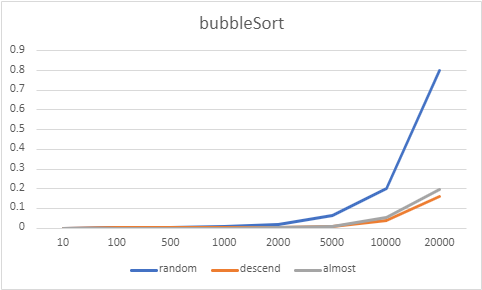
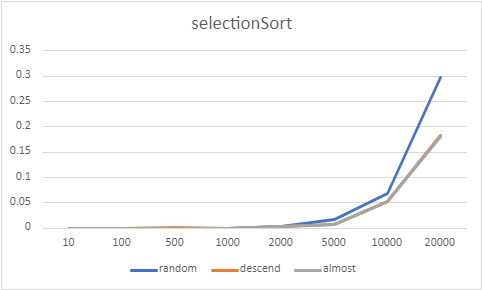
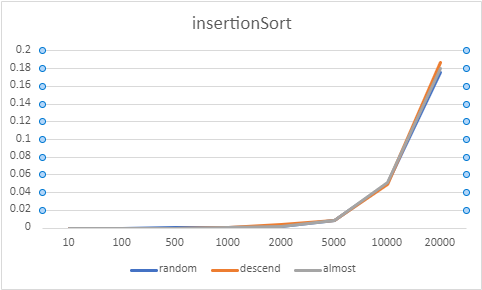
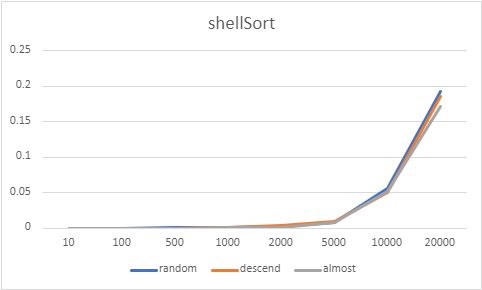
위와 같이 10~20000개의 배열로 성능 구현을 해보았는데, 네 정렬 모두 내림차순 배열과, 대부분 정렬된 상태에서의 배열에서는 비슷한 성능이 구현되었고, 버블정렬과 선택정렬의 경우 랜덤 배열에서는 다른 배열에서보다 성능이 안 좋게 나타났다. 그 중에서도 버블정렬이 가장 성능이 안 좋게 나왔다.