A Rust Load Testing framework with real-time TUI support.




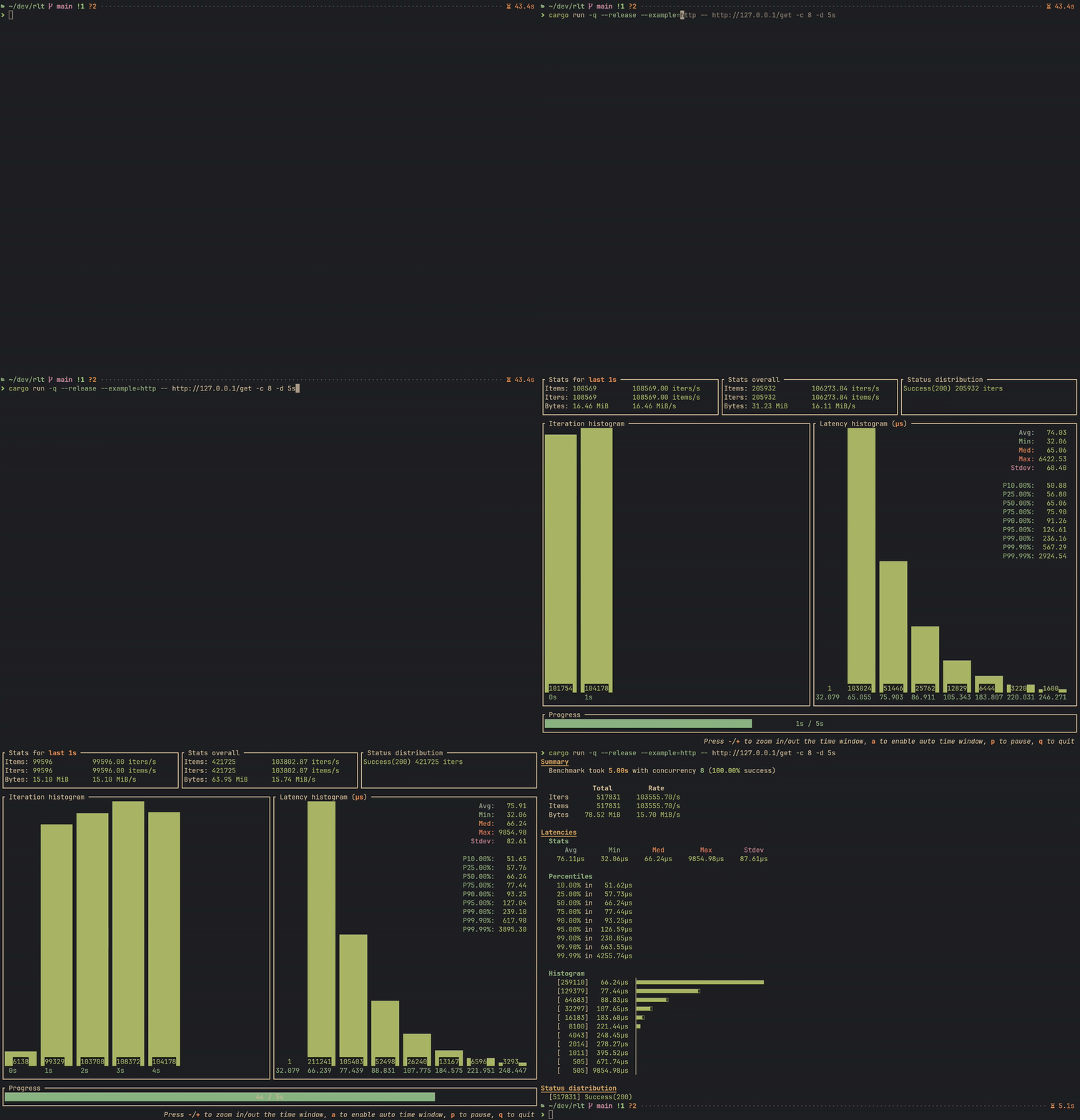
rlt provides a simple way to create load test tools in Rust. It is designed to be a universal load test framework, which means you can use rlt for various services, such as HTTP, gRPC, Thrift, Database, or other customized services.
- Flexible: Customize the workload with your own logic.
- Easy to use: Little boilerplate code, just focus on testing.
- Rich Statistics: Collect and display rich statistics.
- High Performance: Optimized for performance and resource usage.
- Real-time TUI: Monitor testing progress with a powerful real-time TUI.
- Baseline Comparison: Save and compare results to track performance changes.
Run cargo add rlt to add rlt as a dependency to your Cargo.toml:
[dependencies]
rlt = "0.3"For simple benchmarks without per-worker state, implement the StatelessBenchSuite trait:
use anyhow::Result;
use async_trait::async_trait;
use clap::Parser;
use rlt::{cli::BenchCli, IterInfo, IterReport, StatelessBenchSuite, Status};
use tokio::time::Instant;

#[derive(Clone)]
struct SimpleBench;

#[async_trait]
impl StatelessBenchSuite for SimpleBench {
    async fn bench(&mut self, _: &IterInfo) -> Result<IterReport> {
        let t = Instant::now();
        // Your benchmark logic here
        Ok(IterReport { duration: t.elapsed(), status: Status::success(0), bytes: 0, items: 1 })
    }
}

#[tokio::main]
async fn main() -> Result<()> {
    rlt::cli::run(BenchCli::parse(), SimpleBench).await
}For benchmarks requiring per-worker state (e.g., HTTP clients, DB connections), implement BenchSuite.
The bench_cli! macro helps define CLI options:
bench_cli!(HttpBench, {
    /// Target URL.
    #[clap(long)]
    pub url: Url,
});

#[async_trait]
impl BenchSuite for HttpBench {
    type WorkerState = Client;

    async fn state(&self, _: u32) -> Result<Self::WorkerState> {
        Ok(Client::new())
    }

    async fn bench(&mut self, client: &mut Self::WorkerState, _: &IterInfo) -> Result<IterReport> {
        let t = Instant::now();
        let resp = client.get(self.url.clone()).send().await?;
        let status = resp.status().into();
        let bytes = resp.bytes().await?.len() as u64;
        let duration = t.elapsed();
        Ok(IterReport { duration, status, bytes, items: 1 })
    }
}
You can also create a separate struct to hold the CLI options for more flexibility. There is an example in examples/http_hyper.rs.
Finally, create the main function to run the load test using the bench_cli_run! macro:
#[tokio::main]
async fn main() -> Result<()> {
    bench_cli_run!(HttpBench).await
}All benchmarks built with rlt include these CLI options:
| Option | Short | Description |
|---|---|---|
--concurrency |
-c |
Number of concurrent workers |
--iterations |
-n |
Stop after N iterations |
--duration |
-d |
Stop after duration (e.g., 10s, 5m, 1h) |
--warmup |
-w |
Warmup iterations (excluded from results) |
--rate |
-r |
Rate limit in iterations per second |
--quiet |
-q |
Quiet mode (implies --collector silent) |
| Option | Short | Description |
|---|---|---|
--output |
-o |
Output format: text or json |
--output-file |
-O |
Write report to file instead of stdout |
--collector |
Collector type: tui or silent |
|
--fps |
TUI refresh rate (frames per second) | |
--quit-manually |
Require manual quit (TUI only) |
| Option | Description |
|---|---|
--save-baseline <NAME> |
Save results as named baseline |
--baseline <NAME> |
Compare against named baseline |
--baseline-file <PATH> |
Compare against baseline JSON file |
--baseline-dir <PATH> |
Baseline storage directory |
--noise-threshold |
Noise threshold percentage |
--fail-on-regression |
Exit with error on regression (CI mode) |
--regression-metrics |
Metrics for regression detection |
| Feature | Default | Description |
|---|---|---|
tracing |
Yes | Logging support via tui-logger |
rate_limit |
Yes | Rate limiting via governor |
http |
Yes | HTTP status code conversion |
To disable default features:
[dependencies]
rlt = { version = "0.3", default-features = false }| Example | Description | Command |
|---|---|---|
simple_stateless |
Basic stateless benchmark | cargo run --example simple_stateless -- -c 4 -d 10s |
http_reqwest |
HTTP with reqwest | cargo run --example http_reqwest -- --url http://example.com -c 10 |
http_hyper |
HTTP with hyper | cargo run --example http_hyper -- --url http://example.com -c 10 |
postgres |
PostgreSQL benchmark | cargo run --example postgres -- --host localhost -c 10 -b 100 |
warmup |
Warmup phase demo | cargo run --example warmup -- -w 10 -n 50 |
baseline |
Baseline comparison demo | cargo run --example baseline -- -c 4 -d 5s --save-baseline v0 |
logging |
Tracing integration | cargo run --example logging -- -c 2 -d 5s |
rlt supports saving benchmark results as baselines and comparing future runs against them:
mybench --url http://localhost:8080 -c 10 -d 30s --save-baseline v1.0Baselines are stored in target/rlt/baselines/ by default.
Customize with --baseline-dir or the RLT_BASELINE_DIR environment variable.
mybench --url http://localhost:8080 -c 10 -d 30s --baseline v1.0The comparison displays color-coded deltas:
- Green: Performance improved
- Red: Performance regressed
- Yellow: Within noise threshold (unchanged)
# Fail the pipeline if performance regresses
mybench --baseline main --fail-on-regression

# Customize regression detection metrics
mybench --baseline main --fail-on-regression \
--regression-metrics latency-p99,success-ratio# Compare against v1, then save as v2
mybench --baseline v1 --save-baseline v2The TUI layout in rlt is inspired by oha.
rlt is distributed under the terms of both the MIT License and the Apache License 2.0.
See the LICENSE-APACHE and LICENSE-MIT files for license details.
